Crumb
Crumb is the baker's word for the interior texture of a baked good — everything inside the crust. It can be open and airy with large irregular holes, as in sourdough, or tight and fine, as in a sandwich loaf or pound cake. Reading the crumb tells a baker how the mixing, fermentation and baking actually went.
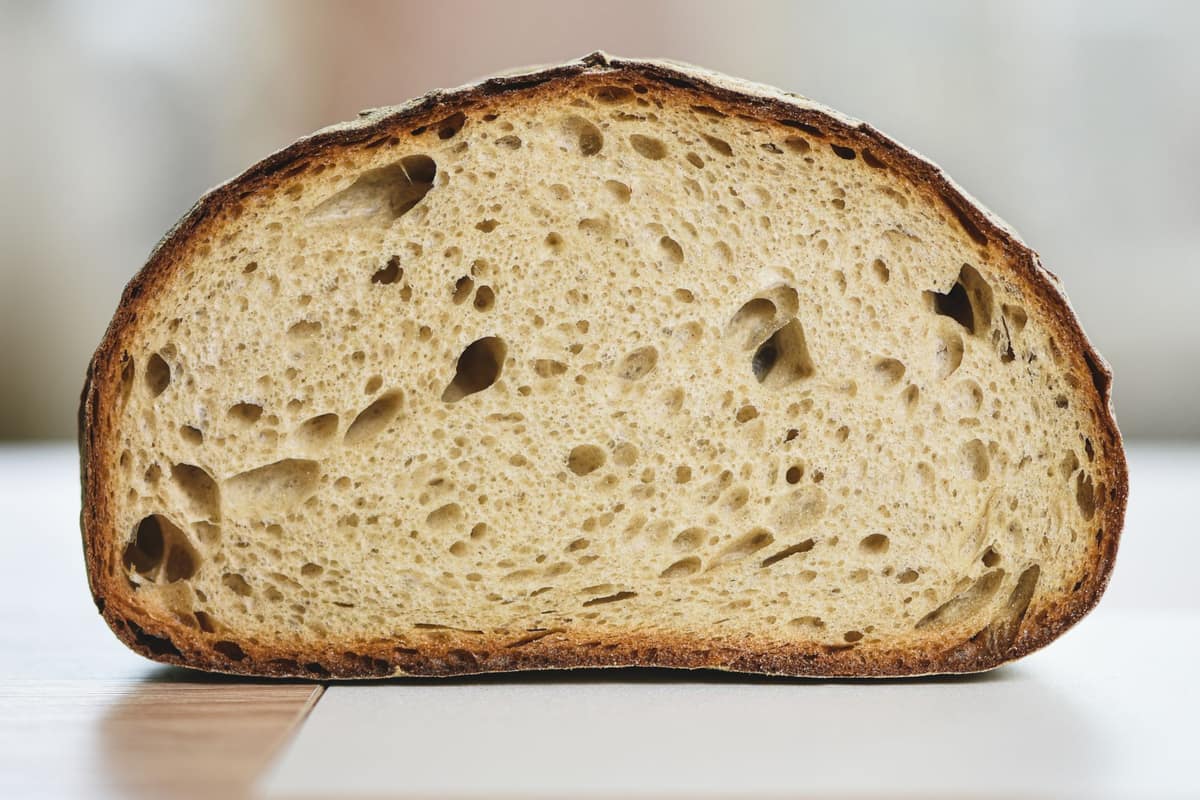
What it is
Slice any loaf or cake and the pattern of holes, the sheen of the cell walls, and the softness under your thumb are all the crumb. The word applies just as much to cakes as to bread: a pound cake, a sponge or a muffin has a crumb every bit as tellable as a loaf. An open crumb has large, irregular pockets left behind by the gas that raised it; a closed or tight crumb has small, even cells. Neither is inherently better — a rustic sourdough wants openness, while a sandwich bread or a butter cake wants fine uniformity.
What the leavening agent does to it
The gas that makes those holes comes from the leavening agent, and which one is used shapes the crumb. Chemical leaveners — baking soda and baking powder — are the common choice in cakes and quick breads, releasing gas fast for a fine, tender crumb. Yeast, a biological leavener, raises fermented breads more slowly. The size of the holes also depends on how long that fermentation runs: a quickly proved burger bun has a tight, fine crumb, while a long, slow ferment develops larger, more open pores.
Why it matters
The crumb is a report card written by the whole process. In sourdough, an open, glossy crumb signals lively fermentation, well-developed gluten and confident shaping. A dense, gummy band near the base suggests underproofing or slicing too soon; big tunnels under the crust point to shaping trouble. Bakers read a slice the way a mechanic listens to an engine.
Common mistakes
The most common one costs nothing to fix: cutting bread while it is still hot. The interior is still setting as steam escapes, and an early slice smears into gumminess that gets blamed on the recipe. Another is chasing dramatic open crumb in every loaf — for sandwiches and toast, a moderately even crumb holds butter and fillings far better.
Related terms
Frequently Asked Questions
What does open crumb mean in sourdough?
An open crumb means the interior has large, irregular, glossy-walled holes. It signals strong fermentation, good gluten development and gentle handling that preserved the gas built up in the dough. It is prized in artisan-style loaves, though it does let jam fall through.
Is a tight crumb a sign of bad bread?
Not at all. A tight, even crumb is exactly right for sandwich loaves, milk breads and most cakes. It only signals a problem when a bread meant to be open and airy comes out dense and heavy — usually pointing to weak fermentation or degassed dough.
Why is my bread gummy inside?
Two usual suspects: the loaf was sliced while still warm, before the interior finished setting, or it was underbaked or underproofed. Let bread cool completely before cutting — the crumb keeps setting well after it leaves the oven.
Tastethetechnique
Everything in our kitchen is baked fresh to order — eggless and vegan variants available.